Our key emission factor datasets and when to use them
Madeleine Ralph
Georgia Pantelidou
Choosing the right emission factors can make or break your carbon accounting. That’s why at Climatiq, we provide the largest database of vetted emission factors to make it easy to find the data you’re looking for. All factors are GHG Protocol compliant and expressed in CO2e (CO2 equivalent) using GWP 100 (global warming potential) so you can trust your reporting is consistent and reliable.
The real power lies in choice. We've aggregated emission factors from over 40 trusted sources including governmental agencies, scientific organizations, and premium providers, all expert-verified by our in-house climate scientists and Scientific Advisory Board. As climate science and regulations evolve, we continuously update our database to keep numbers current.
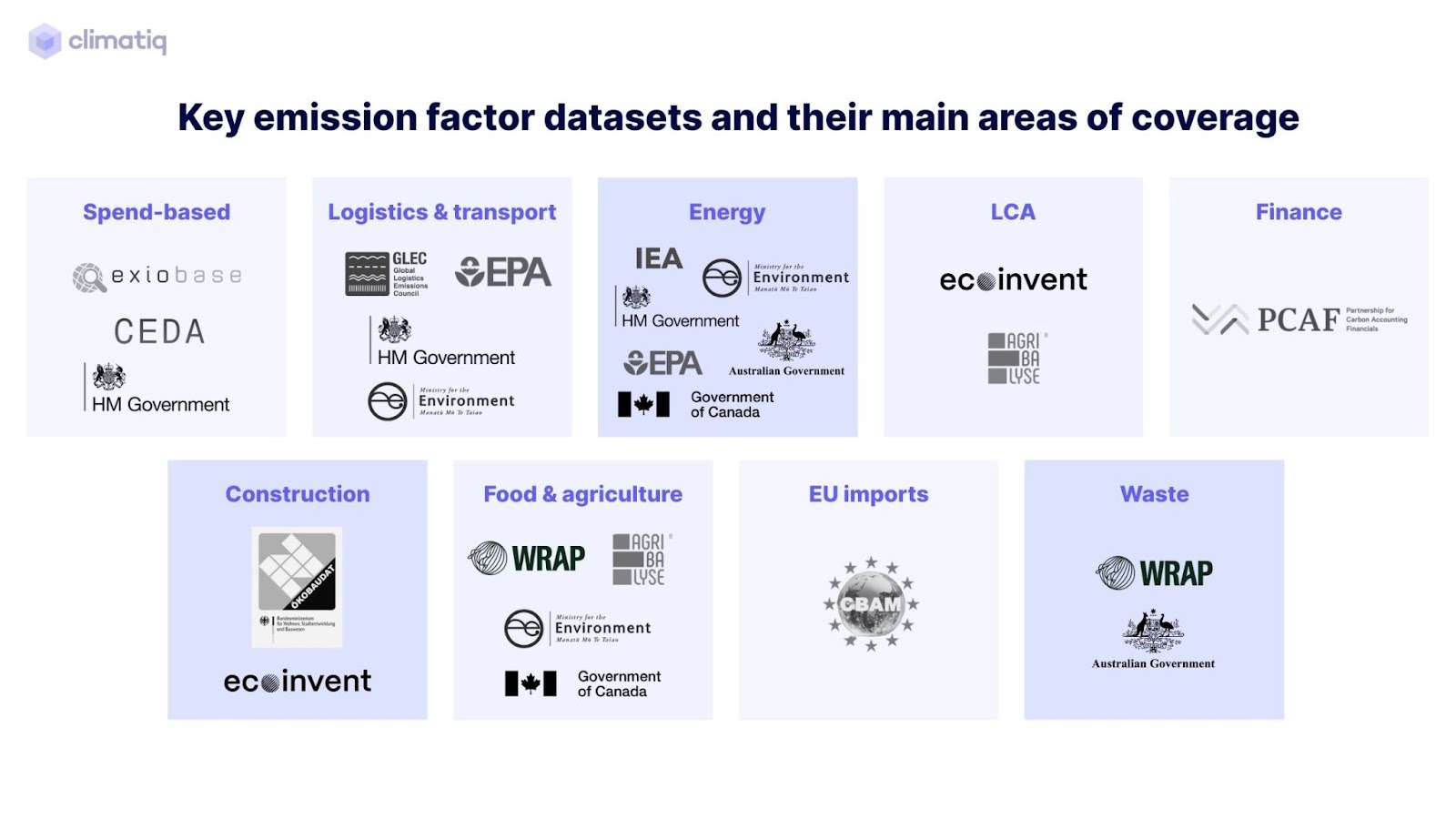
By unifying emission factors into one cohesive schema, we provide a trusted, transparent, and accessible resource which makes it easy to use emission factors from various sources. In this guide, we'll walk you through the most popular of those datasets, their coverage, and their industry applications, helping you navigate which data sources work best for your specific carbon accounting needs.
What it is: EXIOBASE is a detailed multi-regional environmentally-extended input-output (EE-MRIO) database used for spend-based footprinting and cradle-to-gate analysis. It links spending across sectors to environmental impacts.
Primary use cases:
Scope 3.1: Purchased goods and services and 3.2 capital goods
Supply chain emissions when detailed activity data is unavailable
Analysis across 200+ product categories
Geographic coverage: 49 regions globally
Key strengths:
Most comprehensive spend-based emission factor database
Captures upstream emissions from resource extraction through production
Ideal for procurement and purchasing teams
Best for: Organizations needing to estimate emissions when product-level data isn't available or for categories 3.1 and 3.2
Tip: Use Climatiq's Procurement or Autopilot features to automatically handle complex inflation adjustments and price conversions when performing spend-based calculations using EXIOBASE factors.
What it is: One of the world’s most-used life-cycle inventory (LCI) databases, ecoinvent is a Swiss not-for-profit association that supports various types of sustainability assessments, covering 20,000+ activities.
Primary use cases:
Detailed product life cycle assessments
Manufacturing and production processes
Research and detailed sustainability assessments
Geographic coverage: Global, with regional variations
Key strengths:
Granular and detailed emission factors
Premium quality, peer-reviewed data
Best for: Organizations requiring highly detailed, scientifically rigorous emissions data for specific products or processes
What it is: The International Energy Agency (IEA) provides comprehensive electricity emission factors which are essential for understanding the carbon footprint of electricity generation across different regions and energy sources.
Primary use cases:
Electricity consumption by country/region
Energy production and distribution
Country-specific grid mix emission factors
Geographic coverage: 150+ countries
Key strengths:
Most trusted source for electricity grid factors
Regular updates reflecting changing energy mixes
Comprehensive country-level energy data
Best for: Organizations calculating scope 2 emissions across multiple countries
What it is: CEDA is a spend-based emission factor database with 60,000 factors across 400 industries and 148 countries, used for scope 3 reporting, LCA analyses, and sustainable procurement maintained by Watershed.
What it is: Official UK Government emission factors (commonly referred to as BEIS or DEFRA factors) used widely for corporate and public reporting (energy, travel, procurement, etc.).
Primary use cases:
UK-based business operations (all scopes)
Mandatory UK carbon reporting requirements
Geographic coverage: United Kingdom (with some international transport, electricity, and accommodation factors)
Key strengths:
Government-mandated factors for UK reporting
Comprehensive coverage of UK-specific activities
Best for: UK companies or companies with significant UK operations
What it is: United States government agency that provides regularly updated factors for greenhouse gas reporting in the United States. Note: Under the Trump administration, Cornerstone now maintains the US Environmentally-Extended Input-Output (USEEIO) family of models originally developed by the EPA.
Primary use cases:
Scope 1, 2, and 3 calculations for US
Geographic coverage: United States
Key strengths:
Aligned with US regulatory requirements
Multi-scope coverage
Best for: US companies or companies with significant US operations
What it is: ADEME (Agence de la transition écologique) is the French Agency for Ecological Transition which develops Agribalyse, a database offering detailed environmental impact assessments of food products.
Primary use cases:
Food and beverage carbon footprinting
Agricultural products and processes
French regulatory compliance
Geographic coverage: France and broader Europe
Key strengths:
Comprehensive food and agriculture database
Detailed factors for 2,500+ food products
Farm-to-fork life cycle perspective
Best for: Food industry, restaurants, retailers, and organizations with agricultural supply chains
What it is: The German Federal Ministry for Housing, Urban Development, and Building provides OEKOBAUDAT, an extensive database of emission factors for materials and equipment used in construction and building design.
Primary use cases:
Construction projects in Germany/Europe
Building materials assessment
Infrastructure development
Green building certifications
Geographic coverage: Germany, applicable across Europe
Key strengths:
Most comprehensive construction materials database
Government-backed data quality
Best for: Construction companies, architects, and real estate developers
What it is: The Australian Government provides national emission factors, historically managed by the Department of Industry, Science, Energy and Resources (DISER) and now published by the Department of Climate Change, Energy, the Environment and Water (DCCEEW).
Primary use cases:
Greenhouse gas inventory preparation for Australian organizations
General emissions estimation outside of mandatory reporting
Geographic coverage: Australia (national coverage including state-specific electricity grid factors)
Key strengths:
Includes detailed factors for fuel and electricity
State-specific electricity emission factors
Best for: Australian companies conducting voluntary emissions reporting, or organizations seeking alignment with Australia's national inventory methodology
What it is: Environment and Climate Change Canada (ECCC) publishes emission factors for use in federal greenhouse gas protocols and frameworks under Canada’s climate policy.
Primary use cases:
National Inventory Report alignment for Canadian entities
Provincial and federal climate reporting programs
Geographic coverage: Canada (includes province-specific factors, particularly for natural gas and electricity)
Key strengths:
Province-specific natural gas and electricity generation emission factors
Integration with Canada's official GHG inventory
Best for: Canadian organizations preparing GHG inventories aligned with federal protocols or companies seeking consistency with Canada's National Inventory Report
What it is: The Ministry for the Environment (MfE) is the government agency responsible for environmental policy and regulation in New Zealand, providing guidance and resources on greenhouse gas (GHG) accounting and reporting including emission factors of different GHG emissions sources.
Primary use cases:
Voluntary GHG measurement and reporting for New Zealand entities
Climate-related disclosures under Aotearoa New Zealand Climate Standards (mandatory for ~200 largest entities)
Carbon Neutral Government Programme (CNGP) compliance
Geographic coverage: New Zealand
Key strengths:
Extensive transport factors including domestic aviation
New Zealand waste and fuel emission factors
Some international accommodation emission factors
Best for: New Zealand companies meeting climate disclosure requirements
What it is: The Global Logistics Emissions Council (GLEC) is a partnership between industry, government, and non-governmental organizations that aims to develop and promote a standardized approach for measuring and reporting greenhouse gas emissions from logistics supply chain activities, including freight transport by road, rail, air, and sea.
Primary use cases:
Freight transportation (road, rail, air, sea)
Logistics and supply chain transportation
Scope 3.4 (upstream) and 3.9 (downstream) transport
Geographic coverage: Global
Key strengths:
Industry-standardized methodology
Multi-modal transport coverage
Recognized by Smart Freight Centre
Best for: Logistics providers, freight forwarders, and companies with significant transportation emissions
What it is: The PCAF European Building Emission Factor Database provides financial institutions with emission factors for mortgages and real estate across Europe, enabling measurement and tracking of financed emissions by country, building type, and energy performance.
Primary use cases:
Financed emissions (loans and investments)
Scope 3.15: Investments
Geographic coverage: Global
Key strengths:
Industry standard for financial sector
Enables science-based target setting
Best for: Banks, asset managers, pension funds, insurance companies, or any other financial institution
What it is: CBAM is a regulatory tool designed to measure carbon emissions attributed to the production of high-carbon goods imported into the EU, aiming to promote cleaner practices in industrial production across non-EU countries. To this end, the European Commission publishes emission factors providing the necessary metrics for compliance and environmental integrity.
Primary use cases:
EU import compliance for covered products
Scope 3.1 calculations for EU imports
CBAM certificate cost estimation
Geographic coverage: Imports into EU from any country
Covered sectors: Cement, iron and steel, aluminum, fertilizers
Key strengths:
Official EU regulatory data
Best for: Importers into EU, manufacturers exporting to EU, compliance teams
What it is: WRAP provides a comprehensive database for scope 3 food and drink emission factors, employing a consistent methodology that enables businesses to measure and track their supply chain emissions.
Primary use cases:
Scope 3 reporting for food and drink
Geographic coverage: UK and Europe
Key strengths:
Very granular data with clearly defined boundaries; factors cover multiple LCA stages for the same activity
Detailed food factors for supply chain coverage
Best for: Retailers, hospitality, circular economy initiatives
Beyond the top sources: when to explore additional emission factor datasets
While these 15 datasets cover many of the most common use cases, they're just the beginning. Climatiq's database includes over 40 sources designed for specialized needs across different industries and regions. Consider exploring other datasets when you need country-specific factors for markets we haven't covered here, when your industry has specialized databases with more granular data, when you require very specific process-level emission factors, or when regional regulations mandate particular data sources for compliance.
Finding the right dataset doesn't have to be overwhelming. Climatiq's Data Explorer lets you search by activity type, geographic region, or industry sector to quickly identify the most relevant emission factors for your specific situation. Or let our AI-powered Autopilot do the work for you—it automatically matches your activity data to the most appropriate emission factors, ensuring accuracy without any manual searching.





.svg)


