


You're preparing for this year's disclosure when you realize new regulatory requirements mean you need to track previously optional categories—now you need emission factors for employee commuting across five countries, waste disposal by type, and downstream distribution that wasn't in scope before. The hunt for emission factors begins.
If you've been down this road before (it’s probably what brought you to this blog), you know what comes next: a maze of government websites with dusty PDFs, academic databases that don't quite match your use case, or a sprawling spreadsheet someone on your team created two years ago which may or may not still be accurate. The data is somewhere out there, but it's scattered across dozens of sources, riddled with inconsistent formatting, and often out of date.
So where can you find reliable emission factor data when you need it without losing days or weeks to the search?
The first place you can start looking for emission factors is in government databases. These include sources such as the UK Government (including DEFRA and DESNZ) and the Environmental Protection Agency (EPA) in the US.
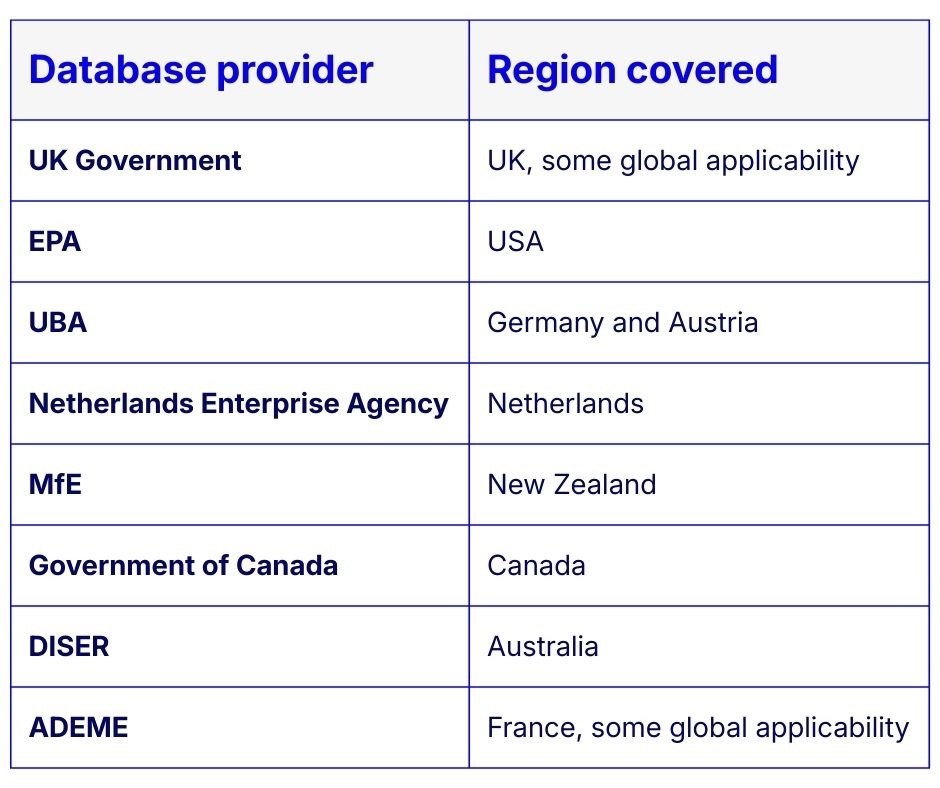
The advantage of government sources is that their data is usually free to access. You can be relatively sure that factors are up-to-date and reliable; annual updates are the norm and usually carried out by trusted experts. However, the factors are of course country specific, giving you only a fragmented overview of emissions. Regional factors can’t be used to calculate emissions globally; this can lead to over- or underestimation of carbon footprint as energy mix and typical manufacturing methods vary across regions. For this reason, it’s necessary to incorporate other emission factor sources.
There are also many emission factor sources backed by research bodies and industry associations. Some of them are long-standing names like ecoinvent; others are newer players making nonetheless valuable contributions to the carbon accounting space. Here are some of the major ones:
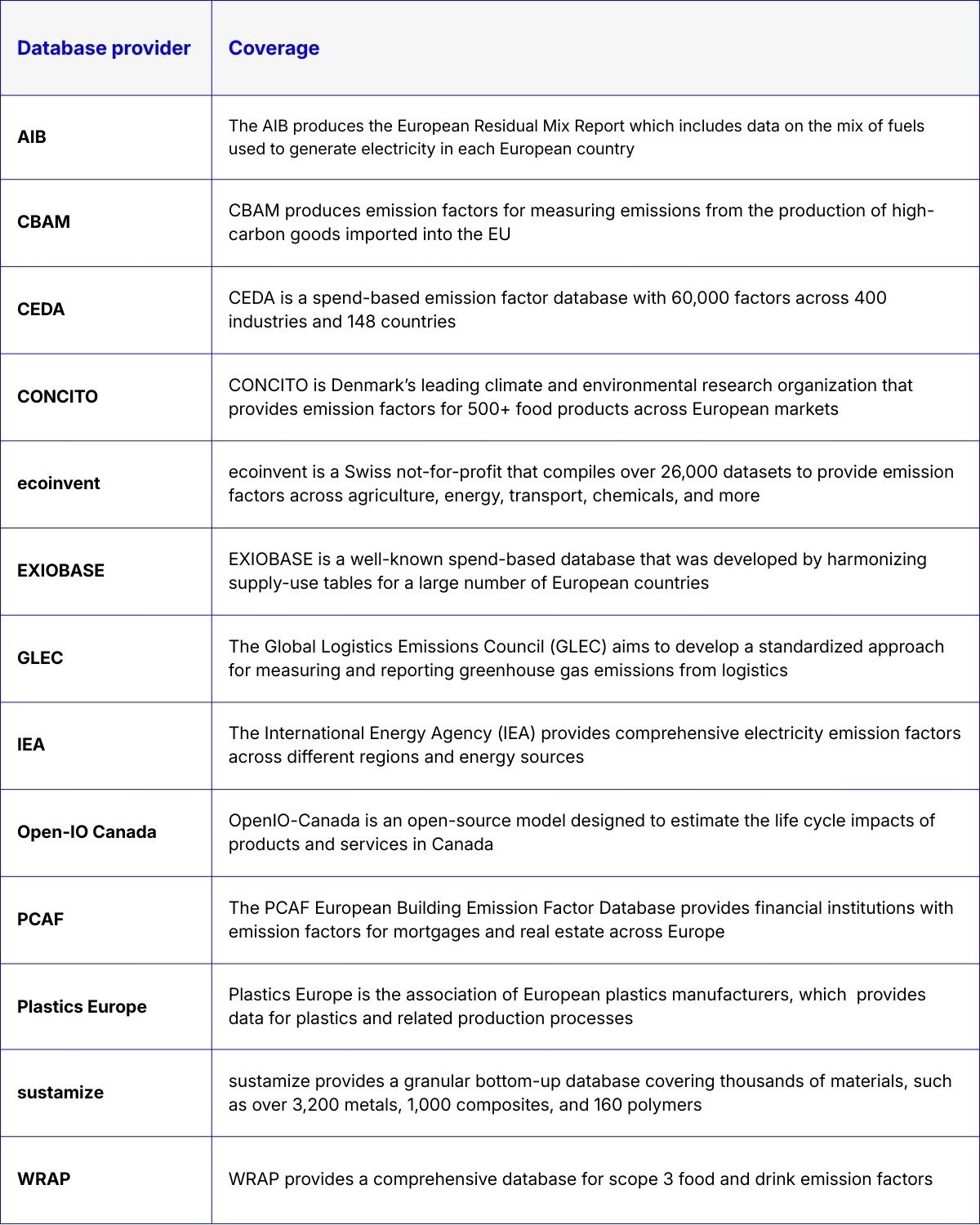
To get comprehensive coverage, consolidating multiple emission factor sources is unavoidable. But this process can be problematic, as it involves:
As Patrick Gold from Change Climate explains, “Previous to Climatiq, we had been aggregating emission factors for a few years. It was turning out to be problematic, taking months of our time to consolidate and process sources. It was just laborious.” You can read more on why it’s so difficult to find the right emission factor data in our blog.
Sustainability professionals often find themselves trapped in an endless cycle of emission factor maintenance: searching through disparate sources, verifying applicability and methodology, downloading and cleaning the data, and updating values with each new release. What should be a straightforward task consumes days or even weeks of work annually, diverting scarce resources from strategic decarbonization efforts. Manual verification and updates pose a significant risk to compliance—errors are nearly inevitable when teams are drowning in repetitive data management.
To overcome these problems, we built the Climatiq database. It acts as an all-in-one emission factor source, compiling data from 80+ datasets for unrivaled coverage while aligning units, automating updates and versioning, and vetting methodology. It consolidates data from governmental organizations, research bodies, NGOs, and lifecycle databases, pulling them all into one source and a single, unified format so that searching for a fitting emission factor is as simple as making a Google search. Updates flow in automatically and every methodology is pre-verified by experts, transforming what used to be weeks of manual review into zero ongoing effort.
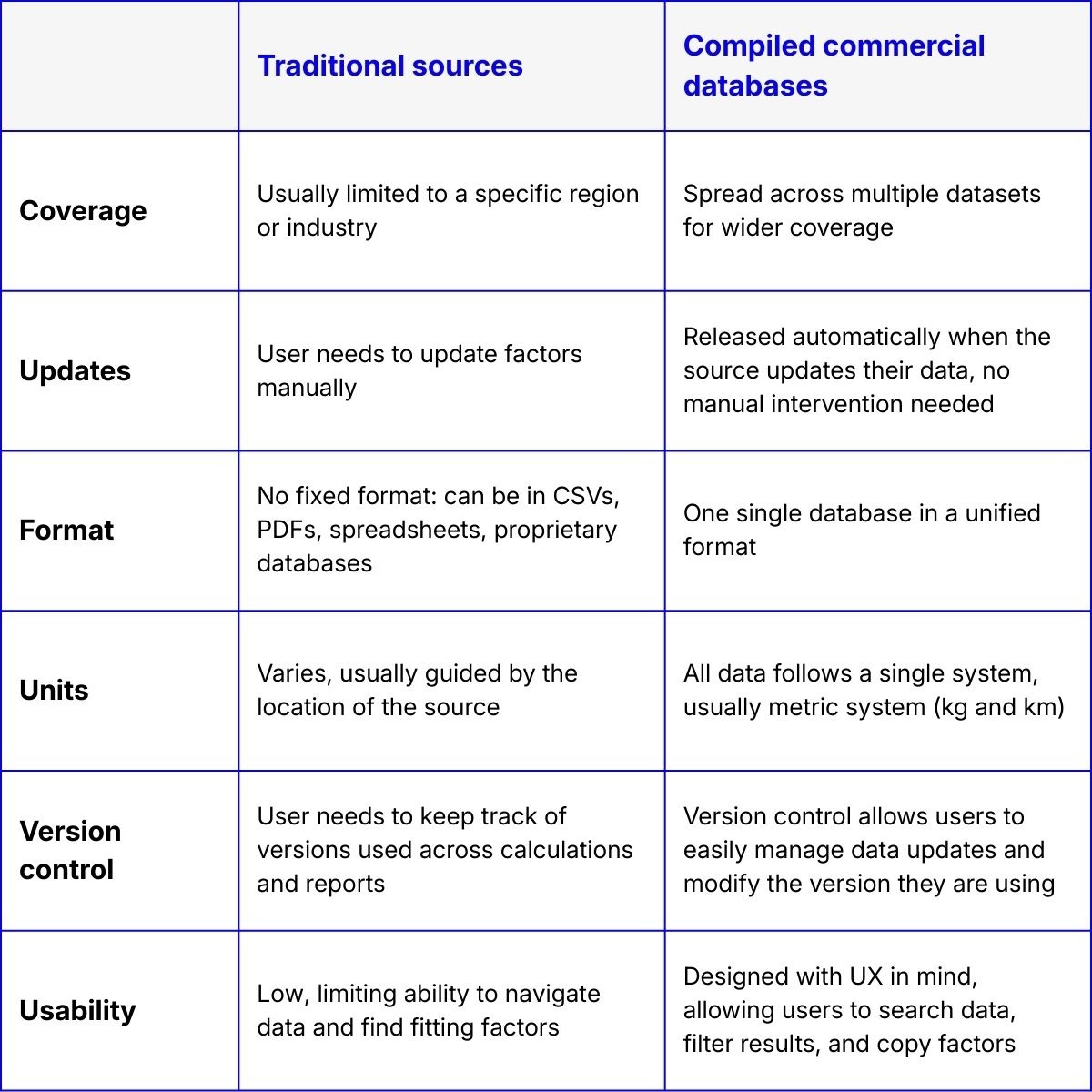
It’s possible to source emission factors manually, but when faced with maintenance headaches, one consolidated source offers a much simpler solution. Climatiq offers an easy way to search for factors across sources, all in one unified format. You can find the—long—list of emission factor sources on our Data Sources page.
For more info on how we vet and update our data, you can check out our Methodology Hub.


.svg)


