


There are two things that can convince business leaders and decision makers to invest: regulatory pressure and commercial advantage. Sustainability isn’t any different.
But sustainability and financial gain aren’t mutually exclusive. When it comes to implementing product carbon footprints (PCFs), a good decision for the planet can also be a good one for the company’s bottom line. Here’s how to measure the ROI of PCFs to decide whether an investment now is worth it in the long run and build a business case for investing in product-level carbon intelligence.
If you’re starting to calculate PCFs, the first thing you’re likely to need is a tool. Without one you’re not going to get very far—at least not at speed—and won’t have a process that scales. That is unless you use consultants, which will set you back financially even more. Sure, there are some free tools on the market, but they are usually one of two things: too complex or too basic. To get a reliable PCF that doesn’t require perfect data or mastery of an overly complicated tool, you’ll almost definitely want to invest in a paid solution to help you. Investing in a good tool will stop you turning to consultants and then ending up with a bigger bill in the long run.
On top of that, any paid emission factor datasets you use (like ecoinvent) will require a license to access the data. Paid datasets are strongly recommended for PCF calculations to get the regional and industry granularity you’ll need for more reliable estimates. The cost of paid datasets varies a lot between sources, but can easily set you back by a few thousand dollars.
It doesn’t stop after you have your final result, either: some stakeholders might require a PCF that’s been audited or verified by a third party. For that, you’ll need to involve an independent verification partner which can come with another hefty price tag. Ideally, you picked a tool that’s had its methodology verified to meet PCF requirements like ISO 14067 and the GHG Protocol Product Life Cycle Standard, which may be enough to satisfy the demands of your customers and prospects. Climatiq offers third-party verification through our partners at a reduced rate for those who need it.
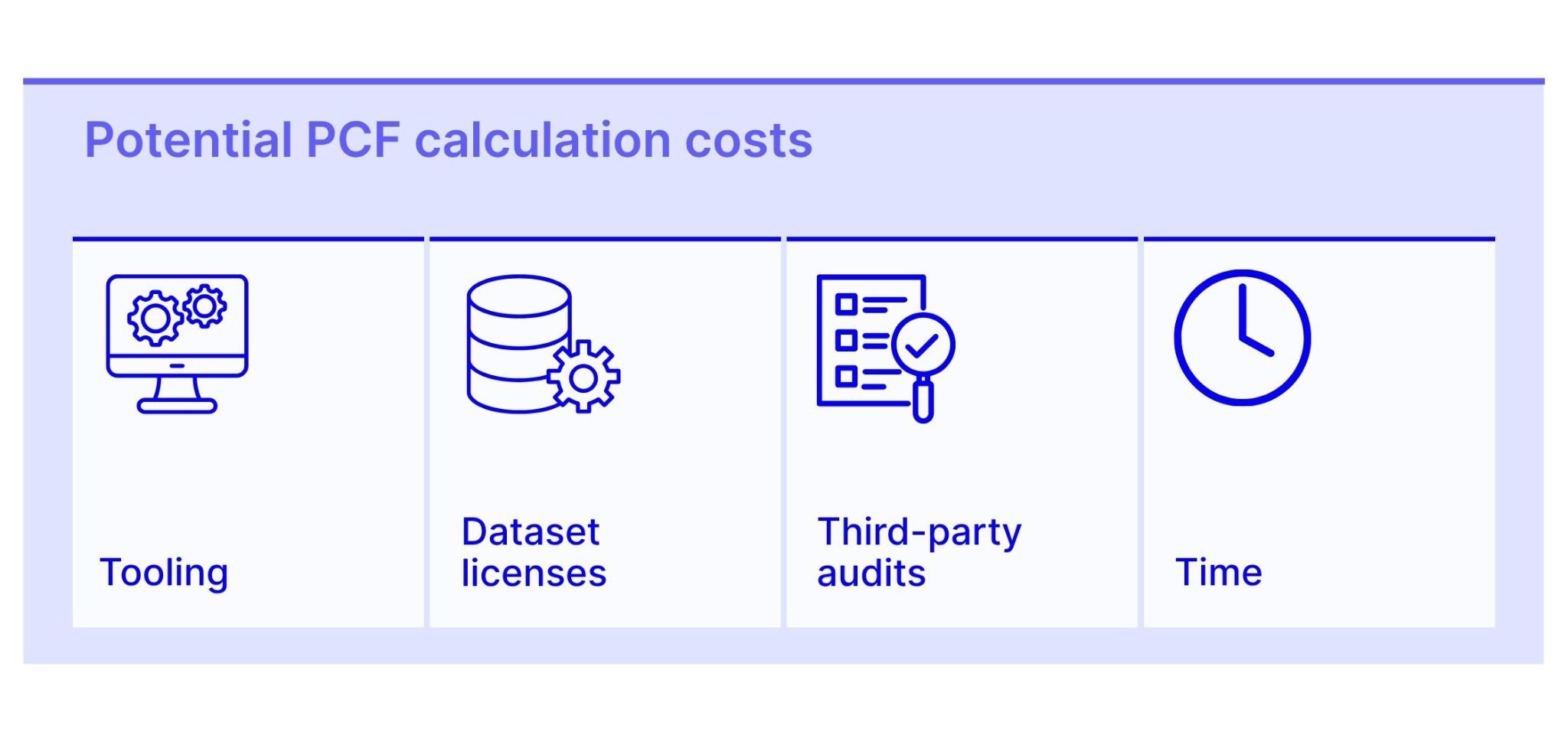
In addition to literal monetary costs, you need to think about how many hours your team members will spend calculating PCFs and who will be involved—perhaps sustainability, procurement, or engineering teams. This is again where your tool selection is critical: pick a complicated tool and you’re going to need extra time and maybe even a specialized hire to use it. Manufacturers we’ve spoken to have told us they would “be able to [calculate] a PCF in a week, so 30 to 40 hours”—a significant time investment when scaled across hundreds of products.
To minimize the amount of time invested in PCF creation, it’s useful to look for a tool that can lessen the data-collection burden by filling data gaps for you and then mapping emission factors automatically. The easier it is to learn, the less time and therefore cost you’ll need to invest.
Calculating PCFs is not usually a one-and-done affair. As your products evolve or you change suppliers, you’ll need to come back and recalculate, adding time and cost to the overall process. Even if your processes don’t change, things like energy grid shifts mean you need to be recalculating your PCFs on a regular basis to keep them up to date. Also consider emission factor data updates and releases, which can easily eat significant amounts of time if your tool doesn’t handle them for you automatically.
As regulations like CSRD start rolling out, the requirements for emissions transparency slowly trickle down the supply chain. According to one manufacturer we spoke to, “we now have PCF requirements from most of our customers. Right now they don’t insist that we need to provide it immediately, but they say it will, sooner or later, be a requirement.” This is especially true for your bigger customers who likely spend more money, as they’re the ones most directly affected by regulatory pressure. Guess what: they’re also the customers you’ll miss the most if you lose them.
In a similar vein, prospects now often make PCFs a part of their selection process. In this case it pays to be prepared: most RFPs have a turnaround of less than two weeks, a timeframe you won’t be able to match if you’re calculating PCFs from scratch. By the time you get a number, the deal will have already gone to someone else.
Products with a clear environmental advantage over competitors can also unlock green pricing. Companies who need to show progress against emissions reduction goals, like those with SBTi targets, are willing to pay a premium for products that help them get there.
When you calculate your PCFs, you might find surprise hotspots you didn’t expect that can translate to material or energy cost savings. Something which could be shipped via sea rather than air, a material you could swap for something more lightweight… Once you have your PCF as guidance, you know your design changes are actually going to make a difference rather than making blind guesses and hoping for a good outcome.
The regulatory landscape around emissions reporting is moving fast, and PCF calculations take time to get right—which makes getting ahead of the curve a smart long-term move. Even if you're not in regulatory scope today, that could change quickly. Or your customers might start asking for PCFs before any regulation forces the issue. Either way, scrambling to calculate emissions across your entire product catalog at the last minute will almost always take longer than you think.
If you’re in an industry that is affected by Digital Product Passport (DPP) regulation, this is even more true. Whether that applies to you or not, the market is heading towards PCFs. Being ahead of the curve helps build efficiency and credibility for the long term.
From 27th September 2026, any environmental claim, like “we’ve reduced our footprint”, “we have more sustainable packaging”, needs actual substantiation under the EU’s Green Claims Directive. Deutsche Bank were already fined €27m for this under an older, laxer, law, and the new legislation is much stricter. Don’t sell in the EU? General anti-greenwashing enforcement is also picking up pace, and you won’t want to be caught out.

So you know what to consider, but how does that translate to numbers? Put a figure against each item under cost-to-produce and value-per-use-case, then tally that across however many times a PCF gets reused. A single PCF often serves multiple purposes: think RFPs, disclosures, and product design decisions. The ROI quickly compounds.
Oftentimes, companies only count the "compliance" use case and miss commercial or operational applications like winning deals. The money topics are the ones that will really win decision makers over; compliance is only ever a deal breaker when it becomes a hard requirement. It’s worth really drilling into how PCFs can win new deals with bigger prospects, and help retain larger customers. Remember also that a single PCF gets pulled into several new deals or decisions, multiplying to its value.
By reframing PCFs as an asset with compounding financial returns rather than a one-off compliance checkbox, the argument in favor quickly becomes much easier to fight. Add fast, lightweight calculation tools to the equation and the initial investment gets even easier to justify, with ROI not so far on the horizon.
If you’re looking for a tool that can turn around PCFs more quickly and cheaply than spreadsheet calculations and consultants, PCF Studio is the answer. Try it out here—your first five PCFs are free, so you'll get very high ROI on those ones!


.svg)


