Request Access to Climatiqs data tool kit.
All posts
August 21, 2026

How to choose a PCF tool: RFP Guide

      How to choose a PCF tool: RFP Guide

      Product carbon footprints used to get buried on page twelve of a customer request. Now, they’ve become a standard line item in RFPs and tenders, and sustainability teams on the receiving end are expected to turn around credible, defensible numbers on a timeline built for procurement rather than life cycle assessment.

      Three forces are driving this:

      • The EU's Digital Product Passport (DPP) regulation will require product-level emissions data for a growing list of product categories, pulling PCFs from a nice-to-have into a deal requirement. The product carbon footprint is one of the core sections of a DPP. Even if your industry isn't directly in scope, somewhere in your supply chain someone is, and their DPP obligations become your problem.
      • Science Based Targets initiative (SBTi) commitments are pushing large buyers to get a handle on their scope 3 emissions, and that pressure trickles down to suppliers regardless of sector.
      • The Corporate Sustainability Reporting Directive (CSRD) is an EU law requiring companies to publish detailed environmental, social, and governance (ESG) data. While CSRD has been scaled down from its original scope, it still affects larger companies, and they pass their reporting requirements down the supply chain.

      As a result, more sustainability teams are being asked to produce PCFs fast (the average RFP turnaround is just three weeks), for a range of products within their large and messy product catalogs. At the same time, they need to hold up to a standard that can withstand a customer or auditor asking how the number was produced.
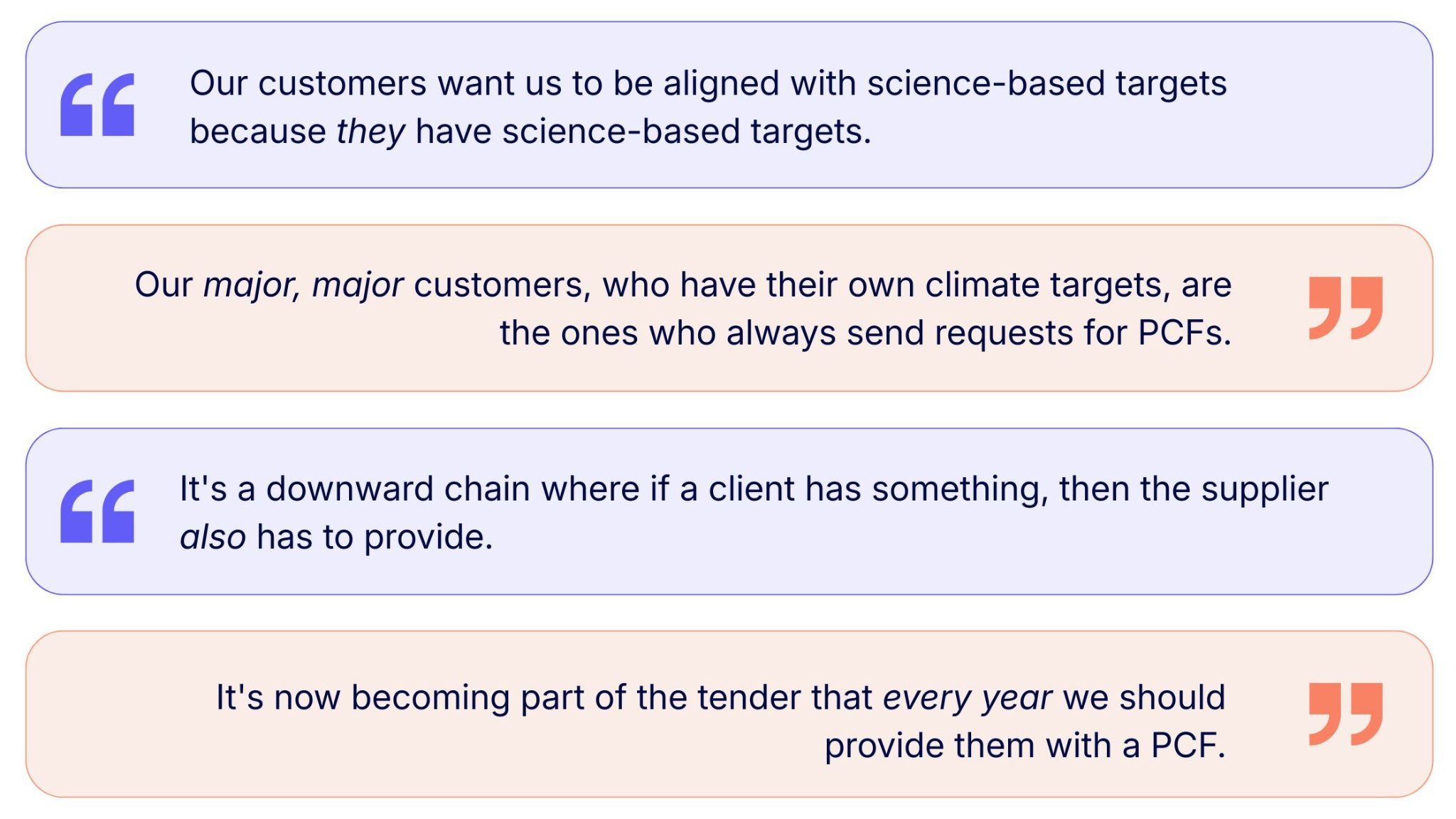
      Quotes from manufacturers on how PCFs are affecting their business

      The combination of speed, scale, and credibility is hard for most teams to meet manually. Some look to agencies to outsource their calculations, but quickly find this is unscalable given the long timelines and high costs. That’s why dedicated tooling is the only way to meet these needs while also remaining conscious of time and budget. 

      This toolkit is designed to help you run the evaluation process for a tool: what to figure out before you start looking, the questions worth putting in front of each provider, and red flags that separate a tool that works in a demo from one that survives real use.

      Before you start: scope the requirements

      Evaluating tools will be easier and faster if you can answer the following questions before the first call with a potential provider:

      • Who is asking for this, and how often? Which customers, and is it a one-off request or a recurring one?
      • How many products or SKUs need a PCF this year? How many will need one next year?
      • Do you have complete bill of materials (BoM) data for those products, or will you need to work with gaps?
      • Who needs to use the tool day to day? Which roles, and how much LCA experience do they bring?
      • Does this need to plug into existing systems (PLM, ERP, etc.), or will it run as a standalone process?
      • What standard(s) do your customers or regulators expect: ISO 14067, the GHG Protocol Product Standard, PACT Pathfinder, or an industry-specific standard that may align with one of these?

      For most manufacturers, answering these questions will point you in the same direction: you need something fast, usable by non-specialists, that is able to scale across a full catalog, and aligned to recognized standards. That combination tends to rule out both traditional LCA software (built for specialists, not speed), uncertified bolt-ons to general CCF (corporate carbon footprinting) tools, and consultancies, which won’t scale to hundreds or thousands of SKUs within a three-week turnaround.

      The evaluation framework: 8 criteria to score every tool 

      Use this framework to structure your RFP and to compare tools. Each one includes why it matters and ready-to-use questions you can drop straight into a questionnaire for your providers.
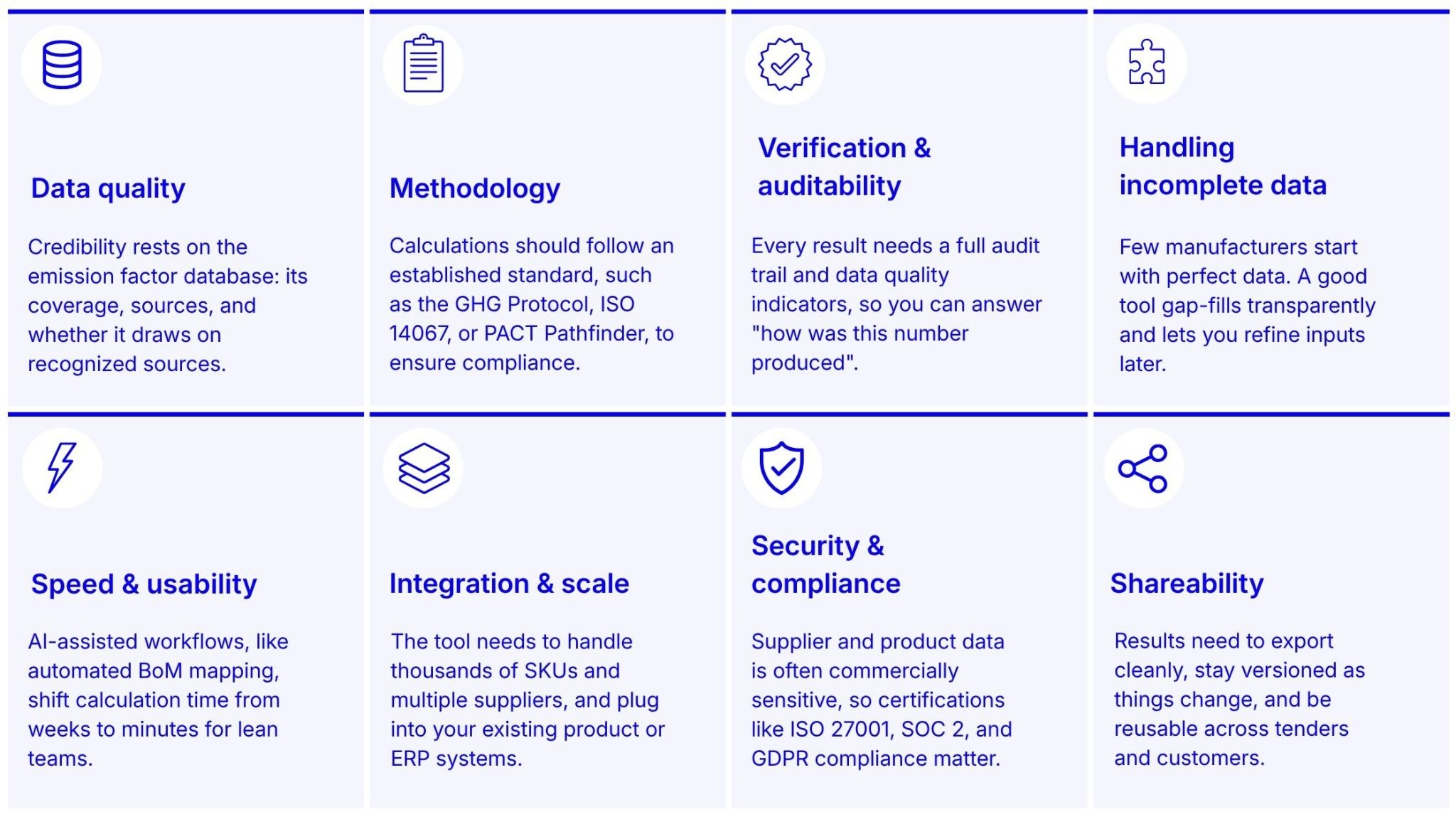
      Data quality

      The PCF is only as credible as the emission factors behind it. Check the coverage and quality of the underlying database, and whether it draws on recognized sources (e.g. ecoinvent).

      Sample RFP questions

      • What emission factor database(s) underpin your calculations?
      • What data is included in the product?
      • What sectors and regions are covered? Can you outline your coverage of X materials / Y regions?
      • Can I see which individual emission factors and sources were used in calculations?
      • What data is included in the product?

      Methodology

      Calculations should follow an established methodology to ensure compliance with frameworks and regulations. For PCF calculations, this usually means following the guidelines laid out by the GHG Protocol Product Life Cycle Accounting and Reporting Standard, ISO 14067, or PACT Pathfinder.

      Sample RFP questions

      • Do calculations follow an established framework? Which one(s)?
      • Have your calculations been externally verified against those frameworks?
      • Which stages of the product life cycle does your calculation methodology cover?

      Verification & auditability

      If a customer or auditor asks ‘how was this number produced,’ the tool needs to have an answer. Look for a full audit trail, data quality indicators, and clear flags on where estimates vs. primary data were used.

      Sample RFP questions

      • Does every PCF result include a full audit trail and data quality indicator?
      • Are results broken down by lifecycle stage?
      • Does the methodology follow ISO 14067 or the GHG Product Lifecycle Standard?
      • How can I get the results audited?

      Handling incomplete data

      Most manufacturers don’t have perfect BoM or energy data on day one. A good tool should gap-fill transparently with adjustable estimates, and let you refine inputs once primary data arrives.

      Sample RFP questions

      • How does your tool handle missing component, energy, or freight data?
      • Can we see and adjust the assumptions used?
      • Can I adjust and refine calculations after getting a result?

      Speed & usability

      Sustainability teams are often a one-person show. AI can support workflows (e.g. automatic mapping of BoM components to emission factors) to improve ease-of-use, shifting the calculation timeline from weeks to minutes.

      Sample RFP questions

      • What is the typical time to get a first PCF result?
      • Does it require advanced LCA expertise to operate?
      • How long does it take to learn the tool?

      Integration & scale

      A tool needs to work across potentially hundreds or thousands of SKUs, multiple suppliers, and maybe alongside your existing product/ERP data.

      Sample RFP questions

      • How long does it take to create a PCF?
      • Can this scale across our full product catalog?
      • Can we integrate the PCF calculations into our own systems? Is it usable with existing AI tools?

      Security & compliance

      You’ll be feeding in supplier, material, and product data that is often commercially sensitive. Certifications like ISO 27001, SOC 2, and GDPR compliance are paramount.

      Sample RFP questions

      • What security certifications do you hold (ISO 27001, SOC 2)?
      • Where is user data stored and processed?

      Shareability

      The end goal is a number you can hand to a customer, put in a tender response, or eventually submit for a DPP. Check how easily results export, and whether you can adjust them as requirements change.

      Sample RFP questions

      • How are results exported or shared?
      • Are calculations versioned so we can track changes?
      • Is a result tied to a single customer, or can it be reused and adapted?

      Red flags to watch for

      Knowing what good looks like is only half the evaluation—you also need to know what to be wary of. For a deeper look at how to separate a credible platform from a good sales demo, see our related guide: How to pick a PCF tool.

      • Vague on methodology: they can't clearly name which standards (ISO 14067, GHG Protocol) their calculations align to.
      • Only material emissions: simplifies the calculation process by ignoring manufacturing and transport emissions, leading to major under estimations.
      • No audit trail: results come back as a single number, with no breakdown by lifecycle stage and no visibility into the assumptions used.
      • Data requirements: the tool requires perfect/complete BoM or energy data to produce any  result.
      • Demo-only scale: it performs well on one sample product in a sales demo, but there's no clear answer for handling hundreds or thousands of SKUs.
      • Security as an afterthought: no clear certifications, or vague answers about where and how your product data is stored.
      • Inflexible output: no ability to export, share, version, or adapt results as requirements change.

      Conclusion: don't trade off speed, scale, or credibility

      PCF tool selection ultimately comes down to three things: speed, scale, and credibility. The problem with most tools is they sacrifice one of them: fast but not rigorous, rigorous but not scalable, scalable but not fast enough for a three-week RFP deadline. 

      You can use the framework above to build your own scorecard, and then send the sample questions with your RFP. After scoring each provider against the same seven criteria, you’ll have a clearer answer on who is actually meeting them.

      If you’re rather looking for a free option to first dip your toes in the water, you can check our list of five free product carbon footprint calculators here.

      Ready to see a fast, scalable, and credible PCF workflow in practice? See how PCF Studio takes you from a BoM to a shareable result within minutes (your first five PCFs are free).

      FIRST PUBLISHED

      August 21, 2026

      Tags