

A product carbon footprint (PCF) request lands in your inbox. Already the pressure starts mounting to get it “right”—PCFs are tricky things. The obvious first step: start collecting primary data to use as the basis for your PCF.
Before you go hunting for primary data, it's worth asking what it even is—and moreover, how much it matters. The assumption is that primary data means a better, more credible PCF. While that can be true, it comes at a high cost: companies lose time and momentum, based on a misunderstanding of how PCF data actually works.
In a world where such data is at best elusive, and more often non-existent, here we will explore what primary data is and what it means, along with the reasons why we (along with PACT) recommend getting started with the data you actually have first. Once the processes are in place, then you can spend time refining with primary data. This is the approach that will help us create PCFs at scale and meet decarbonization goals.
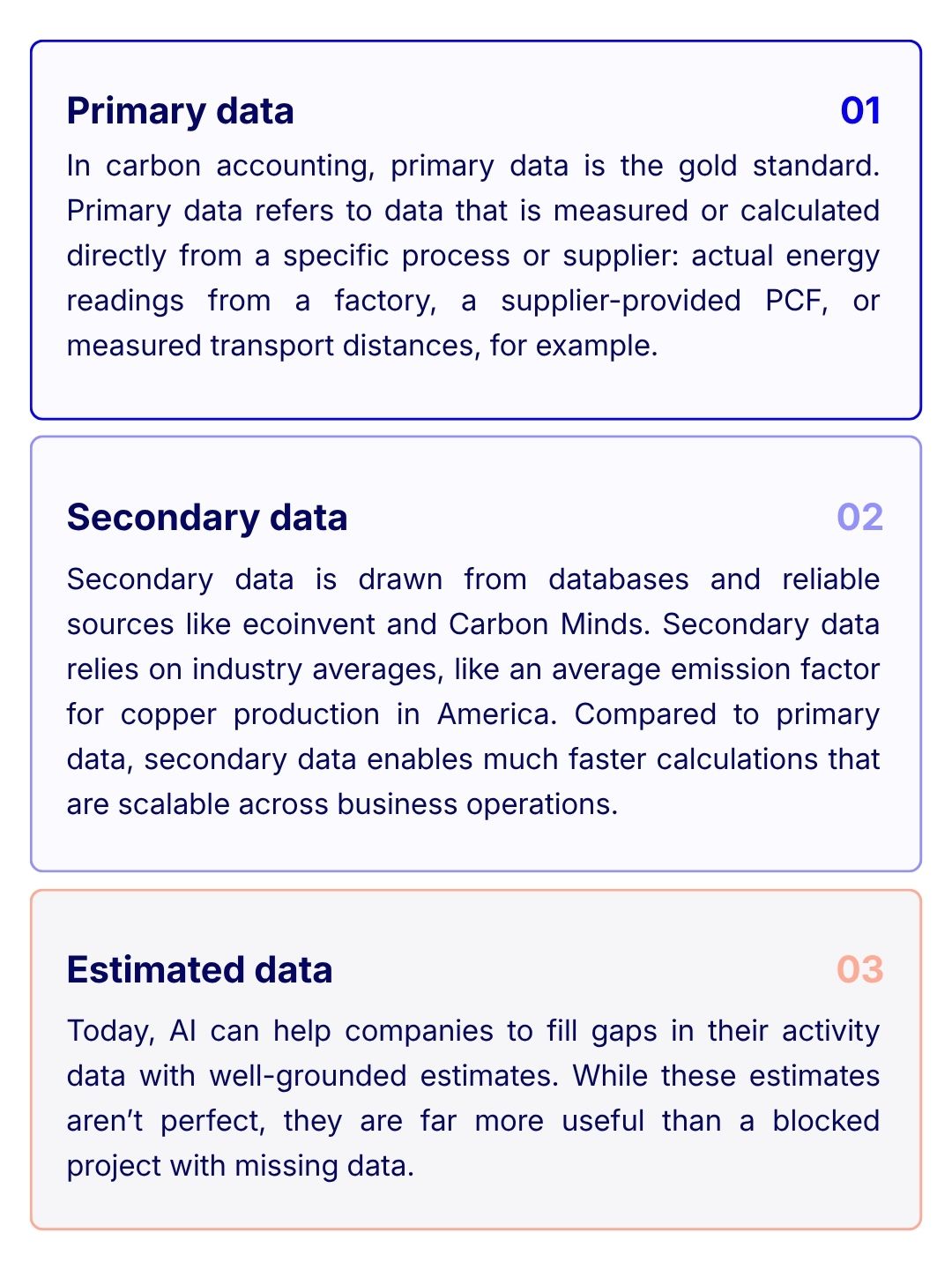
In carbon accounting, primary data is the gold standard. Primary data refers to data that is measured or calculated directly from a specific process or supplier: actual energy readings from a factory or measured transport distances, for example.
Primary data yields more reliable PCFs but it is very difficult, time-intensive, and costly to collect. Most companies can’t simply stroll into a power station and collect energy readings. Even a lot of “primary” data is created using secondary emission factors, energy grid models, and supplier estimates, which means it’s not strictly primary data. That’s why secondary data is much more common, and why the vast majority of PCFs are a mix of the two. Even the supplier-provided PCF you receive is likely calculated using secondary data.
This blurs the line between what is primary data and what is secondary data. In reality, the distinction is more of a spectrum than a binary, and the gap in reliability between them is smaller than you think.
You should always aim for primary data where possible—but almost no one is physically measuring the emissions coming out the exhaust pipes of their freight vehicles. So if getting the most accurate data isn’t possible, where do we draw the line?
Little known fact: standard LCAs carry roughly a 20% accuracy on final figures, and this is the industry-accepted norm. The uncertainty across hundreds of inputs, variability in emission factors, and methodological choices mean trying to get a higher degree of accuracy is very complicated from the beginning.
If your final figure has a plus/minus 20% range regardless, what are you going to gain from pushing for primary over secondary data? The result is likely very small; having something to work from now rather than later is better than waiting for primary data that isn’t going to move the needle.
But carbon accounting professionals can’t be blamed for trying. Traditional LCA tools force you into a process of exhaustive data collection, supplier questionnaires, and primary data requests. That makes it easy to focus on the details of the processes and lose sight of the bigger picture.
Traditional tools send the message that you can't produce a credible PCF without hitting a certain data completeness threshold. As a result companies spend months collecting data that moves their final figure by less than the uncertainty already built into the methodology. As the saying goes, perfect is the enemy of progress; in PCFs, it's the enemy of done.
Even PACT, the Partnership for Carbon Transparency on whose PCF methodology most footprints are based, says that “waiting for 100% primary, fully verified PCFs means never starting,” and favors running pilots with partial or estimated data for the sake of progress.
So you’ve reached a point where collecting primary data is not practical or doable. What should you be doing instead? It’s useful to define accuracy relative to its purpose. For the most part, customers and procurement teams are looking for a few simple things to give them peace of mind so they can stand behind the PCF you provide:
Major frameworks like PACT and the GHG Protocol recognize the use of secondary data in your PCFs when primary data is unavailable or difficult to collect. There are just a few things you need to keep in mind:
.jpg)
Your PCF process doesn’t need to be a data collection nightmare. Realistically, it means using secondary data consciously, applying reliable and vetted emission factors, and disclosing data quality transparently so that anyone reading your PCF understands what they're looking at. There is no clean line between primary and secondary data, and chasing precision beyond that roughly 20% margin only slows the whole process down without any substantial gain. The goal is to get the most credible PCF practically achievable, produced in a timeframe that matters.
Because the uncomfortable truth is this: there won't be a path to better data in a few years if companies aren't building PCF muscle now. Progress today is what creates the conditions for precision tomorrow, and we can’t get there if we’re endlessly waiting.
To see how easy a credible PCF process can be, try out PCF Studio and get to a first estimate within minutes.


.svg)


