

AI is everywhere. Your software, emails, and potentially even your microwave now claim they’re AI-powered. In a field built on regulations and audit trails, it’s understandable that many sustainability professionals are hesitant to hand over the reins to AI. At the same time, calculating product carbon footprints (PCFs) leaves them with real data problems that can take months of work to resolve. In this reality, the question isn’t “should we use AI?” but rather “how can we find smart ways to apply AI?”
Sustainability teams have two major—but avoidable—problems when trying to create PCFs. Firstly, the lack of activity data: whether that’s partial BoMs or missing energy data, there are almost always gaps between what data is needed and what is actually available. If a single component, material, sourcing location, transport route, manufacturing process, energy reading, or fuel source is missing, suddenly your calculation can’t be completed. Trying to source that data takes up a huge amount of time—in fact, the majority of time taken for PCF calculations tends to fall under acquiring data. Calculation efforts fall at the first hurdle because data is missing.
Secondly: emission factors. Sourcing and matching emission factors to component and manufacturing data requires hours of sorting through disorganized and potentially inaccessible sources, wrangling data to get it consistent, and then manually updating it whenever there’s a new release. These tasks cost actual climate progress by stealing time away from decarbonization strategy.
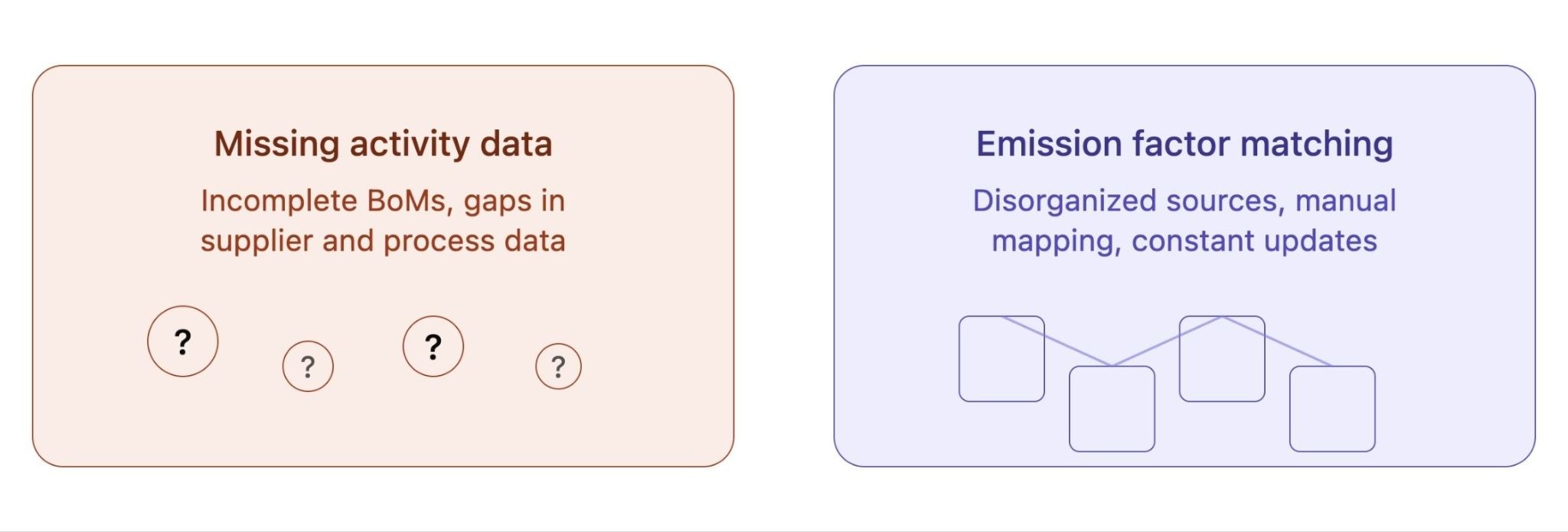
AI's core strength is pattern recognition—finding structure in data and matching new inputs against what it's already seen. For PCF calculations, that translates directly into two high-value tasks:
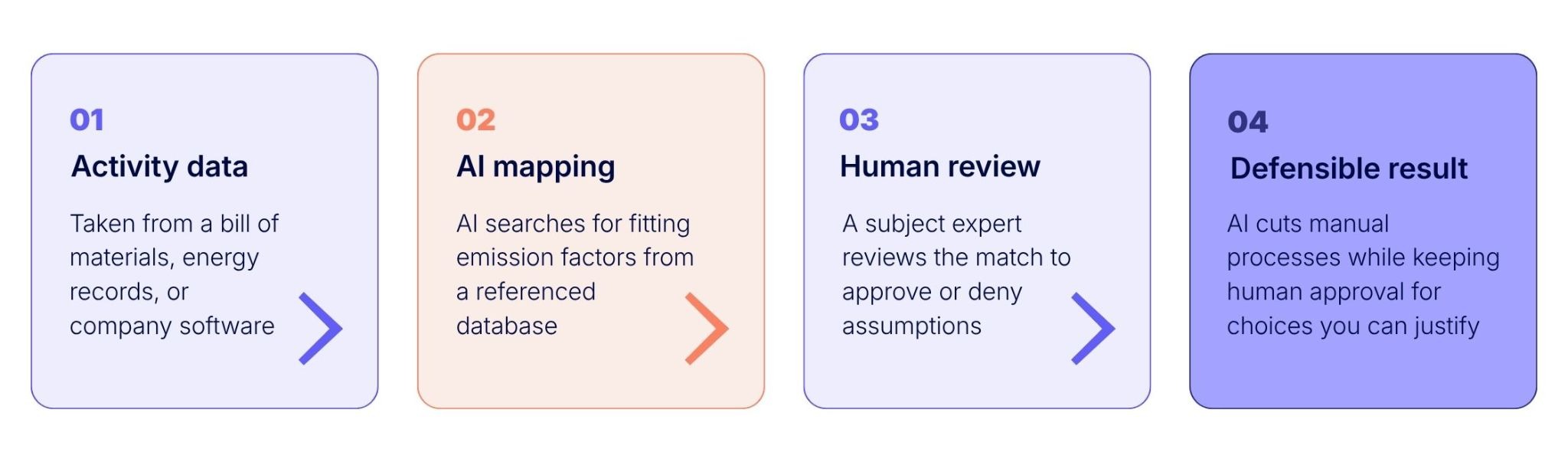
Given the right inputs and access to relevant databases, AI can do this at a speed and scale no human could match manually.
But speed only matters if the output is trustworthy. That's why in any workflow, AI should suggest, and a human with domain expertise can review and approve before any decision is final. For that review to mean anything, the reviewer needs full visibility into the AI's reasoning: which emission factors it selected, what assumptions it made, and why. That transparency is what makes the number defensible. When a customer, auditor, or regulator asks "how did you get this figure," this ensures you can justify your results with confidence.
This means that progress on sustainability goals doesn't have to wait for perfect data or more headcount. AI can fill in the gaps and match the factors in a fraction of the time it would take to source perfect data and map factors manually.
That means more products can be assessed, more often, without sacrificing reliability, leading to faster iteration cycles and PCF calculation workflows that scale. This gives teams more time to spend on important projects like supplier engagement, design changes, and reduction efforts—things that move the needle—rather than clocking in minutes fussing over data sourcing, entry, and maintenance.
Climatiq’s AI-powered Mapping Agent automatically maps business activity data to relevant emission factors. However, we understand that selecting the right emission factor is rarely a straight-forward task, and the selection often hides assumptions and choices that materially change the results. Those assumptions and choices need to be transparent and easily accessible for you to understand, trust, justify, and act on the results.
That’s why we include multiple features in Mapping Agent to help you stay in control so you can review and tweak mappings as needed:
This ensures you can trust and understand the results, are able to explain them to customers and auditors, and can act on them without second-guessing.
When it comes to filling data gaps, you keep control over any suggestion Climatiq makes, with full autonomy to tweak the result as you see fit to more accurately reflect your processes. This means you can get started estimating PCFs without perfect data and then refine by supplementing with primary data as and when it becomes available. The result: you can open up your PCF bottlenecks, turning endless waits into answers and action.
Meeting climate goals means finding new ways to accelerate clunky manual processes. Handing tasks over to AI can feel unsettling, but for labor-intensive workflows like PCF calculations, which can take weeks or even months, it can save a huge amount of time and budget.
At the same time, we know that transparency, explainability, and documentation is critical for trust and defensibility when using AI in sustainability. That’s why we provide the documentation and reasoning you need to be able to justify your choices, with the option to edit any assumptions and always make the final call.
To give it a go, you can try PCF Studio here (your first five PCFs are free).


.svg)


