


If you’re a manufacturer selling to large enterprises with SBTi commitments or CSRD requirements, you need to deliver PCFs sooner than you think — otherwise you’re putting deals on the line.
Even if you don’t sell to these companies, it’s possible your customers do, and their reporting requirements will soon start filtering through to you.
That gives you a choice: find a way to get your customers and prospects credible PCF data fast, or watch as every deal becomes a lot harder to close.
Every week, we speak to manufacturers who hadn’t heard of PCFs two years ago, but now need to routinely deliver them for RFPs. This pressure is growing, and the manufacturers that can't provide reliable PCF data are worried about being cut from supplier shortlists or being repriced — not because of poor performance, but because they create compliance headaches their customers don’t want to deal with. Meanwhile, the companies that can provide clean, verifiable, product-level PCF data are making themselves the easy choice for long-term contracts.
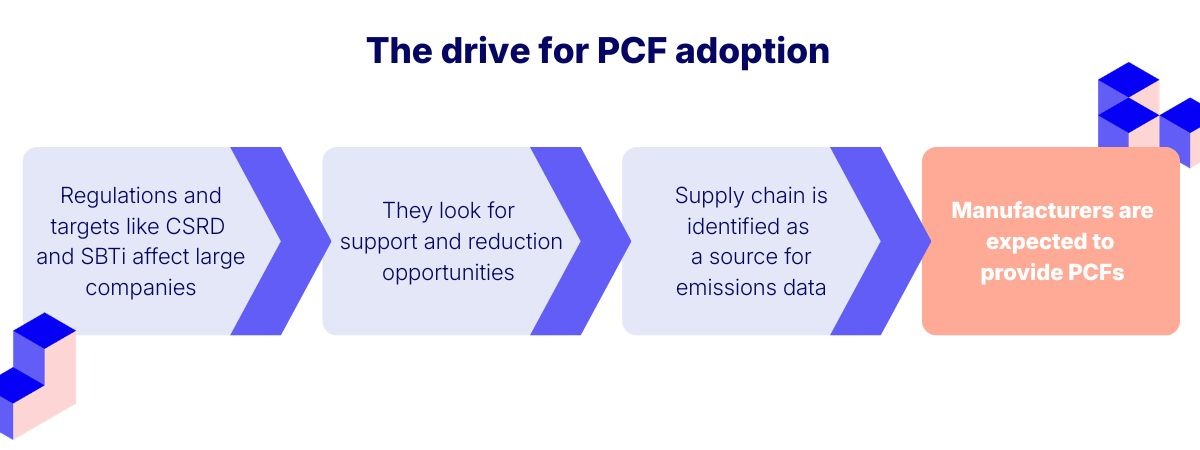
Companies including DuPont and BT have made PCFs a mandatory requirement in their procurement process, and they aren’t alone. This is driven by two things: regulation and net zero commitments. The Corporate Sustainability Reporting Directive (CSRD) is bringing detailed value chain disclosure requirements to tens of thousands of European businesses, and those businesses need product-level data from their suppliers to meet them. Beyond CSRD, the Digital Product Passport, rolling out across several product categories from 2027, will require manufacturers to attach verifiable environmental impact data including carbon footprint directly to their products.
Beyond regulatory requirements, many companies with SBTi targets need to account for their scope 3 emissions, and this is significantly easier for them with PCF data from every major supplier. Between regulatory compliance and voluntary climate commitments, the demand for product-level carbon data is growing quickly.
This means that even if you don’t directly have reporting requirements, the pressure cascades and your customers' obligations quickly become your problem. The infrastructure of procurement is being rebuilt around product-level transparency, and the companies that find a way to start now to get ahead of customer demand will be the ones holding the contracts.
Despite the growing demand for PCFs, the manufacturers we speak to don’t yet deliver them routinely. This comes down to a myriad of reasons, from data through to reporting standards and the calculation processes currently available.
The first, and biggest, barrier is data availability. A credible PCF requires reliable data, not industry averages. Our customers at manufacturing companies tell us that sourcing activity data with enough granularity — that means components, weights, locations, freight journeys, energy used, etc. — is hard, especially when they have complex, multi-tier supply chains. Even when manufacturers do have data, it's often not detailed enough for PCFs: knowing that you procured a certain weight of steel is one thing, knowing how much energy was used to manufacture that quantity of steel is another.
This lack of data impacts many teams that use traditional PCF or Life Cycle Assessment (LCA) software. These tools can provide very reliable results, but they rely on precise data that can be hard to source, and are difficult to use without extensive training. As most sustainability teams don’t have either the data foundation to work with these tools or the time to dedicate to learning them, they aren’t a viable option for delivering PCFs.
Even with a strong data foundation, sustainability teams tell us they have problems with the complexity of PCF calculations. Manufacturers need to ensure that their calculations are correct and comply with industry standards like ISO 14067 or the PACT methodology. Getting that wrong creates reputational and commercial risk if you can’t answer customers’ (or their auditors’) questions about your figures. Building these complex calculations in Excel is extremely time-consuming, error-prone, and doesn’t allow for version control or any kind of meaningful audit. For customers with reporting requirements, unverifiable calculations won’t cut it.
For one-off projects, many companies have hired specialist PCF consultants. However, this approach is slow and quickly becomes extremely expensive to deliver at scale. Indeed, by outsourcing projects, sustainability teams don’t build their in-house PCF expertise, limiting their long-term impact on PCF projects.
The result is that manufacturers face real market pressure for PCFs but have no practical way to produce them at the speed or scale the market now demands. In competitive tenders, they start losing out on deals because they can’t supply the product-level data their customers need, and compliance issues simply aren’t an inconvenience customers can afford to deal with.
If any of these apply to you, you probably need PCFs:
You may not need a full portfolio overnight, but you do need somewhere to start, and tools that can scale with you — or you risk being cut from supplier shortlists or repriced.
That's exactly what we built PCF Studio for: a tool that's simpler than traditional LCA software, more affordable than consultants, and designed to scale. It's built for sustainability, operations, and finance teams to run reliable PCF calculations and share results with customers, partners, and prospects without needing to be an LCA expert.
To try PCF Studio, you can request access here.


.svg)


