


Across the market, we're hearing the same thing from companies of all sizes: customers and prospects are starting to ask for product carbon footprints (PCFs). What's currently an optional disclosure in procurement will soon be mandatory, and lead to you being excluded from RFPs. And when it does, you'll face a real question: given how much money and effort goes into producing even a single PCF, is it actually worth it?
The short answer is yes, emissions targets and regulations mean that the demand for PCFs you’re seeing is only going to grow. But the more interesting answer is that the value of PCFs goes well beyond ticking a compliance box. Done right, they're a commercial asset, a design tool, and a signal to the market that you're a supplier worth partnering with for the long term. Combined with the fact that modern tools slash the amount of money you need to create PCFs, it's a no-brainer.
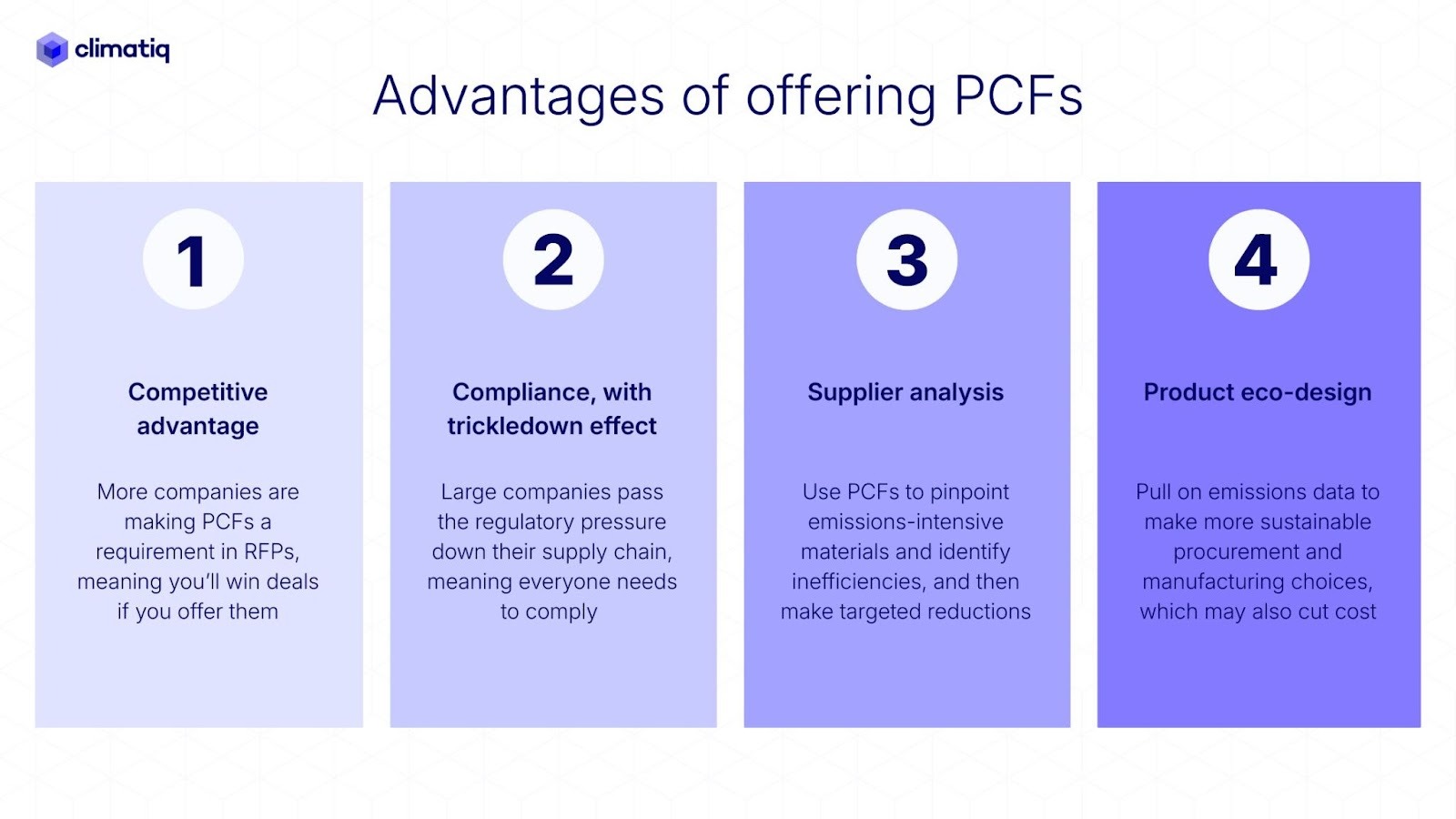
PCFs have quietly become a differentiator in supplier selection. More and more companies, particularly large enterprises, are making them a requirement in RFPs, not as a nice-to-have but as a gating criterion. Companies like BT, the NHS, and dsm-firmenich already state that PCFs are part of their selection process, and that in the next few years they’ll become mandatory.
At the moment, that makes having no PCF data awkward, but manageable. As one manufacturer we spoke to put it, the conversation is “uncomfortable”.
Soon, “uncomfortable” will become “untenable”. As sustainability expectations trickle down supply chains from large corporations to their mid-market and SME suppliers, PCFs will be part of the data you need to supply within any major RFP or RFQ.
Typical RFP timelines mean that this isn’t something you can handle when it comes up—it needs advance preparation. Half of RFPs give you only three weeks to respond, whereas manufacturers tell us that producing a single PCF from scratch takes months. If you have to assess and onboard tools, as well as organize your internal data for the first time, that will be far longer and the contract will have gone to someone else.
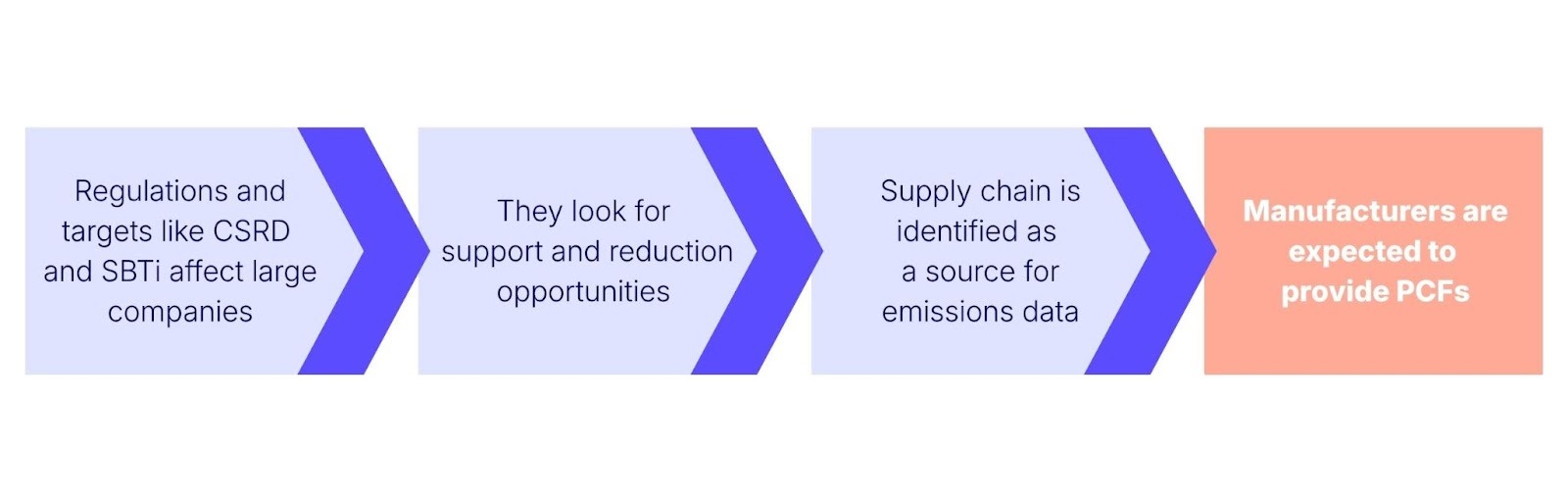
Behind many of these requests is a compliance driver for your customer. Regulations like CSRD in the EU and emissions target frameworks like SBTi are pushing larger companies to take their emissions seriously.
While CSRD and SBTi don't specifically mandate PCFs, getting product-level data from suppliers is the efficient and accurate way for large companies to assess their scope 3.1 (purchased goods and services) emissions. As this category typically makes up the bulk of a company's footprint, many are making reporting and reducing supply chain emissions a priority.
Until now, many companies relied on spend-based emissions calculations for this. But spend-based calculations fall short when it comes to offering actionable, product-level insights, and can even falsely reflect your emissions profile. If you switch to more sustainably sourced materials, for example, your costs might go up even as your emissions go down. Spend-based methods would make it look like your footprint increased, even though you're making the right choices and decreasing real-world emissions. PCFs remove that distortion, and give companies far more clarity on their supply chain’s emissions.
Crucially, this compliance pressure doesn't stop at tier-1 suppliers, it cascades. Requirements can quickly filter through the whole supply chain, meaning that even if you don't actively sell to any companies with SBTi targets or CRSD requirements, you still need to supply PCFs.
PCFs aren't just something you produce for customers. They're also a lens for looking inward. The creation process involves mapping out materials, origin locations, transportation modes, and electricity consumption. With this data across your inputs and processes, you can pinpoint emissions-intensive materials and identify inefficiencies. Especially in current times where political unrest is encouraging fickle energy prices, this kind of data is invaluable in helping you to not only make emissions reductions, but also targeted cost reductions.
And just as your customers might use your PCF to inform their procurement decisions, you can do the same with your own supply chain. One manufacturer we spoke to claimed “[PCFs] help us build a knowledge base for us to begin decarbonizing the supply chain.” Putting pressure on your suppliers for lower-carbon products means you can pass that benefit downstream, strengthening your own competitive position in the process.
Introducing simple, accessible PCFs tools to your company and teams also allows for eco-design. This allows you to use PCFs as a modeling tool during the design process, whereby design teams pull on emissions data to make more sustainable procurement and manufacturing choices. By opting for accessible tools with low technical barriers, designers have the opportunity to model impact independently without having to call on the expertise of other team members, making eco-design a habit rather than a bottleneck. Meanwhile, sustainability and design teams start genuinely collaborating rather than sustainability being a retrospective audit on design decisions that were already made.
This gives you a competitive advantage over less emissions-conscious suppliers and products. But there are other financial benefits, too: introducing PCFs into the design stage brings attention to processes that can be optimized or expensive materials that can be swapped. For example, one manufacturer told us they now “take three [material] options, see what the difference is impact-wise, and then if that corresponds to something that can be an economic gain, it's a no-brainer to develop that way.”
Accessible and usable tools lower the entry point to PCFs, embedding emissions-aware decision making across functions. And as sustainability enters other teams’ radars, it eventually will spread all the way into the boardroom.
All of this value only materializes if the investment required to produce PCFs is manageable. Historically, that's been the sticking point.
Responding to RFPs with quick turnaround times or having your design team create PCFs requires a new type of PCF tool. Most legacy solutions are so complicated that you need extensive training to use them, and it still takes months to create a PCF—from 100 to 300 work hours, according to manufacturers we’ve spoken to.
Until now, this has been a barrier to starting PCFs. That’s why we wanted to create a simpler tool that makes product-level footprints accessible to everyone. Climatiq’s PCF Studio combines certified calculations with the world’s largest database of emission factors to deliver PCFs in minutes instead of months. It allows you to easily integrate your primary data, with automatic BoM uploads and material mapping, while using AI to fill gaps so you don’t need perfect data to get started. Our GHG Protocol, ISO 14067, and PACT-aligned calculations do the rest. That means you can respond to PCF requests quickly, win more deals, identify supplier hotspots, make smarter procurement decisions, and design more carbon-aware products.
According to manufacturers we’ve spoken to, “[their] competitors now have PCFs ready. And the clients, the big ones, are already pushing on it.” The sentiment across the board is that to keep up with (and bypass) the competition and win deals, PCFs are a must.
Legacy PCF tools do require a large upfront investment, but newer options are making it easy to get ahead. To play catch up, you need a simple way to create PCFs with a quick time-to-market. Forward-thinking sustainability teams can get in touch with our sales team here to discuss integrating PCF Studio and start winning deals.


.svg)


