

If you've spent any time in the world of sustainability reporting, you've almost certainly encountered both terms—product carbon footprint (PCF) and life cycle assessment (LCA)—often used as if they mean the same thing. In a meeting, someone will talk about "an LCA" when they’re actually talking about a customer request for a PCF. In a report, the two will appear side by side as if interchangeable. It's an understandable mix-up, but it can also be a costly one.
At their core, both PCF and LCA are tools for understanding environmental impact. But as more companies start introducing PCFs as a requirement in their supplier selection, manufacturers will have to come to terms with the myriad of frameworks relevant to PCFs and LCAs and what they need to provide. Understanding the difference between the two is the first step to knowing what you need to produce—and avoiding potential embarrassment and extra costs that could come from responding to your customer with the wrong thing.
Life cycle assessment (LCA) is a method for evaluating the environmental impacts of a product, process, or service across its entire lifespan. LCA traces impacts from raw material extraction through manufacturing and use, all the way to end-of-life disposal. This ensures that environmental burdens are not simply shifted from one stage of a product's life to another.
ISO 14040/44 is the international standard that defines the LCA framework. It establishes the four-phase structure that any life cycle assessment must follow: goal and scope definition, life cycle inventory, impact assessment, and interpretation. Think of it as the rulebook for how you systematically trace a product's environmental footprint across its entire life, from raw material extraction through to end of life (waste and disposal of a product).
ISO 14067 takes that same framework and applies it specifically to greenhouse gas emissions. Rather than assessing a product's full range of environmental impacts such as water use and radiation, it narrows the lens to CO2e to define how you quantify, communicate, and verify a product's carbon footprint.
Sitting alongside these is the Greenhouse Gas (GHG) Protocol Product Standard. It provides a way to slot product-level emissions reporting into the wider company reporting that many companies are already familiar with so the two make sense alongside each other.
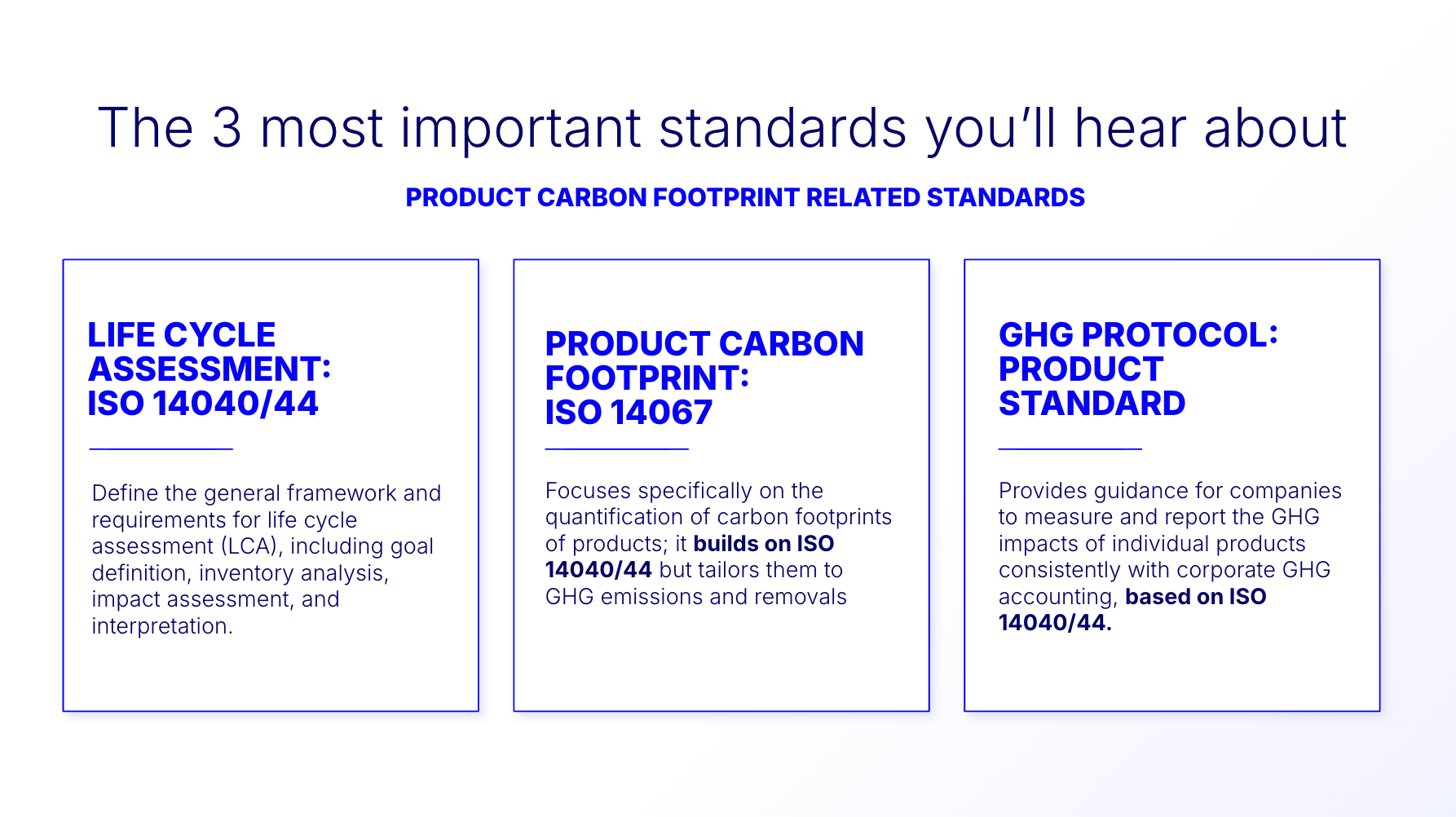
While the ISO standards provide the overarching framework, they don’t provide a specific methodology to conduct an LCA study. It’s recommended to use the Environmental Footprint (EF) v3.1 method to fill this gap and get guidance on implementing the ISO framework.
EF v3.1 provides a set of rules for doing an LCA in line with European reporting requirements. It covers up to 16 environmental impact categories, including climate change, acidification, eutrophication (freshwater, marine, and terrestrial), water use, land use, and resource depletion (minerals and metals), among others.
A product carbon footprint (PCF) represents the greenhouse gas emissions associated with a product dependent on the chosen life cycle stage, calculating raw material extraction and manufacturing emissions, as well as use and end-of-life disposal when a full cradle-to-grave footprint is needed. It accounts for all relevant inputs and outputs, including materials, energy consumption, and waste, each of which flows into CO2e values to produce a single, comparable measure of climate impact.
The PCF approach is built directly on the LCA framework established by ISO 14040/44. However, ISO 14067 applies ISO 14040/44 specifically to carbon footprinting, with dedicated guidance for quantifying and communicating a product's CO2e emissions. ISO 14067 does not replace or sit above the LCA framework, but rather operates within it, translating the general requirements of ISO 14040/44 into specific procedures for carbon footprinting.
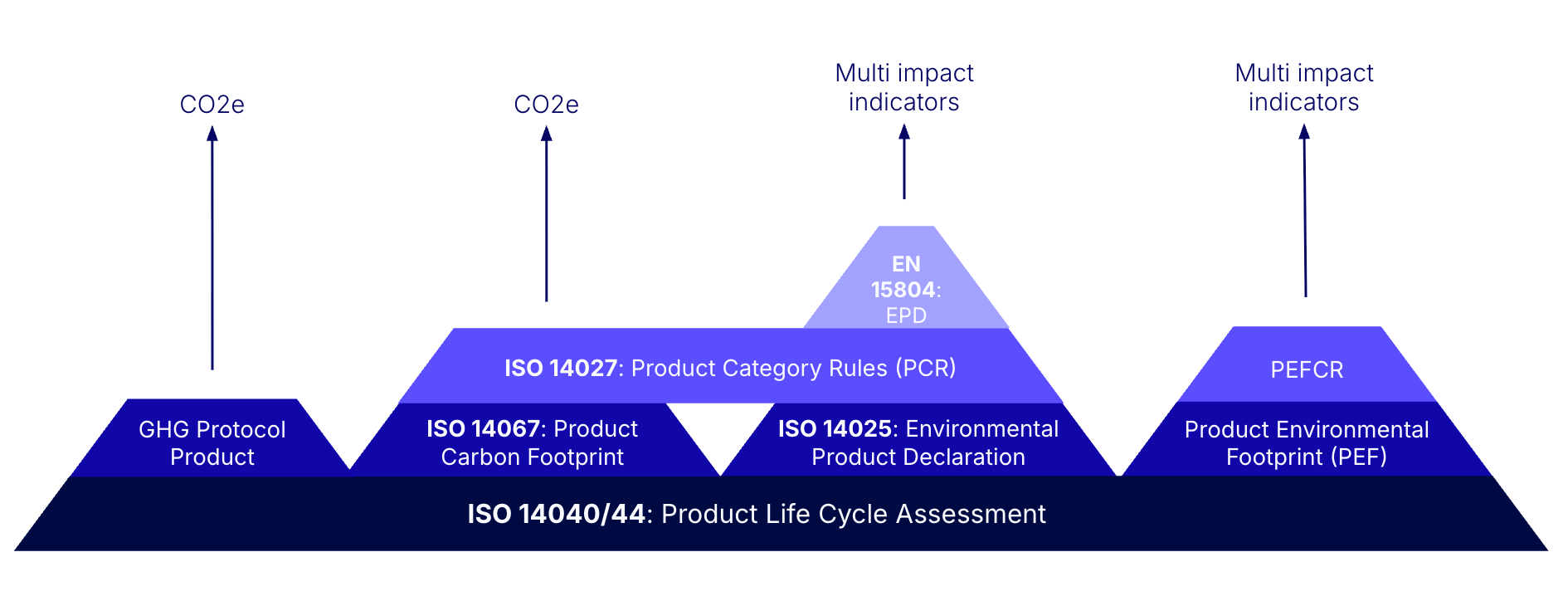
With as many as 16 different categories to consider, LCAs can quickly get complicated. If you want to synthesize the results into a single depiction of environmental impact, you have to juggle indicators simultaneously while prioritizing one over the other in terms of its severity. Comparing products becomes very difficult for beginners who aren’t LCA experts—if product A is better on CO2e, but product B has an advantage on water consumption, what should be the next step? In this case, the complexity of LCAs can become a blocker to taking action on the data and improving the environmental impact of a product.
A PCF, on the other hand, gives you a single metric to consider: CO2e. Its more targeted focus makes the data actionable, allowing you to easily document emissions, identify major hotspots, and avoid decisions that simply shift pollution from one life cycle phase or region to another. As one company we spoke to explained, "PCFs are a good starting point. It's not as rigid and time-consuming as a full LCA is, and also getting a long LCA with a big data sheet third-party verified is more expensive."
As it stands, there is more primary data (data that is measured or calculated directly from a specific process, like energy readings from a factory) and secondary data (background data drawn from databases like Climatiq or industry averages) for CO2e than other environmental impacts. It’s relatively easy to quantify emissions by looking at the amount of fossil fuels burned or electricity consumed—which is data many companies already have to hand. There are almost no companies that measure other indicators at the process level. Not only the companies, but also the databases: beyond GaBi and ecoinvent, environmental data providers tend to focus on CO2 only. This is part of the reason that PCFs are garnering more attention than LCAs—for now.
The EU's Corporate Sustainability Reporting Directive (CSRD) is pushing large companies to disclose the environmental impact of their supply chains. While manufacturers might not be directly affected by the regulations, somewhere in their value chain, a customer is. They inevitably pass the requirement to disclose their scope 3 emissions straight down the supply chain as a precursor to every procurement decision. As one manufacturer we spoke to put it, "The number one reason [we calculate PCFs] is customer requests ... It's now becoming part of the tender that every year we should provide them with a PCF."
Customers aren't asking for full LCAs. When they come to you with an RFP requesting sustainability data, PCFs are the currency of the conversation. They need a PCF with a number backed up by credible methodology and evidence it was done properly so they can rest easily when the auditor comes calling. You can read more on how regulations are forcing PCFs in our blog.
PCFs are less complex than LCAs, but they’re still very difficult to deliver without the right tools. For manufacturers who are just starting to offer product-level insights, overcomplicating the process even further by providing LCAs is an unnecessary addition to an already heavy load, and will be extremely expensive. As regulation matures, we may reach a point where LCAs are needed—through PEF and ESPR delegated acts, for example. But to make headway on reducing environmental impact, PCFs are enough for the vast majority of sustainability reporting needs. To keep up with the competition, you should be focusing on being able to proactively offer PCFs before your customers even ask for them rather than getting deep into LCAs—unless you have to. To summarize:
If you’re looking for an accessible way to implement PCFs without perfect data and deep expertise—and without having to get deep in the weeds of ISO standards—you can check out Climatiq’s PCF Studio for credible, quick, and customer-friendly PCFs.


.svg)


