



Challenge: Building a credible, data-driven carbon impact dashboard for a first-of-its-kind circular economy app in India
Ramakrishna Iyengar, founder of PassItOn, set out to do more than build a swap app. He wanted to prove with real numbers that giving things away instead of throwing them away makes a tangible difference to the planet as well as the community. They couldn’t make hollow, unsubstantiated claims; as Ramakrishna put it, "We wanted a trusted source. That's where I found Climatiq, and we are very happy with what it provides."
Building that trust from scratch presented three distinct challenges:
- Sourcing high-quality, scientifically credible emissions data: PassItOn needed emissions factors that could withstand scrutiny, backed by scientists and engineers.
- Covering a sufficiently broad range of items: PassItOn users give away everything from furniture and electronics to clothing and plants, needing access to a large, comprehensive database of emission factors.
- Integrating carbon calculations seamlessly into every transaction: Building and maintaining carbon calculation infrastructure internally, while simultaneously developing the app, growing a user base, and operating as a non-profit, was not a viable path.
Solution: Climatiq's API gives PassItOn the data depth, scientific credibility, and developer simplicity to make carbon impact a core feature
After discovering Climatiq, Ramakrishna and his team integrated the API directly into PassItOn's transaction flow, so that every completed handover automatically calculates and logs the carbon saved. The result is a live impact dashboard that users can see, share on social media, and feel proud of.
Key benefits of Climatiq's API for PassItOn:
- A trusted, science-backed data source that users can interrogate: Climatiq's database is maintained by scientists and engineers, and “the quality of data is much higher than what we could source ourselves,” according to Ramakrishna.
- A 1-million-factor database that eliminates gaps in coverage: Climatiq's extensive database of emission factors ensures the vast majority of contexts are covered.
- Rapid, friction-free integration that lets the team focus on product: The PassItOn engineering team had the Climatiq API up and running in under half a day. "It didn't take more than a couple of hours to get it up and running. The documentation is super clear and the Climatiq teammates were really helpful when we had questions."
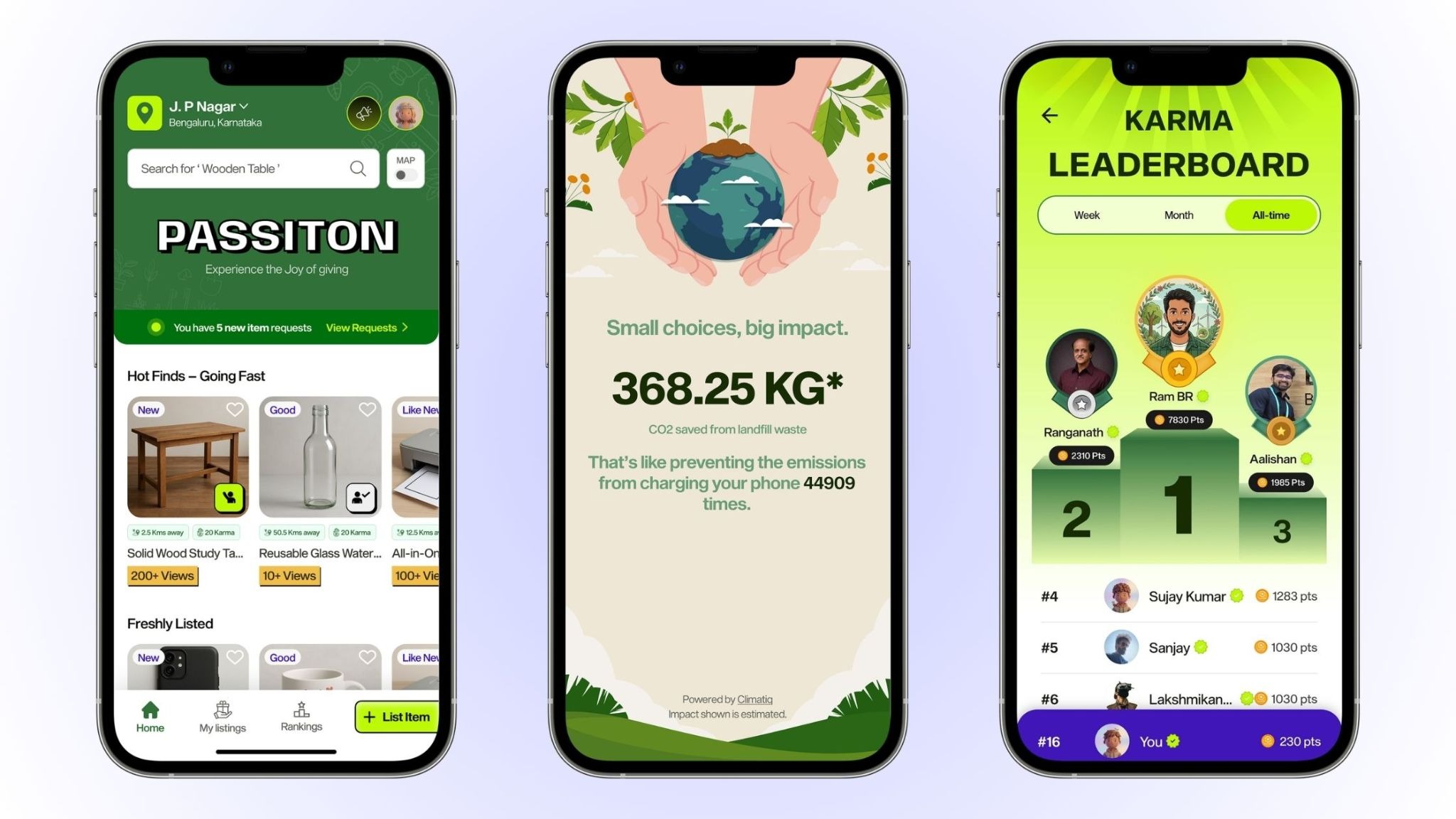
Goodbye clutter; hello carbon transparency
PassItOn launched to strong early traction, onboarding 10,050 users in its first two months, with users already sharing their carbon impact scores on social media. Ramakrishna describes the essence of the platform as "bidding goodbye to an item, but in a conscious way."
Looking ahead, PassItOn is building on this foundation in two significant directions. First, the team plans to introduce a karma-based rewards, where their points-based system will make points redeemable for surplus goods donated by partner companies. Those same partners will receive carbon-saving badges they can display publicly.
Second, and perhaps most significantly, PassItOn is well-positioned to ride a major cultural shift. Net zero commitments are gaining momentum among Indian businesses, and climate consciousness is growing rapidly among younger generations. As sustainability becomes a mainstream expectation, PassItOn's combination of community-driven exchange and rigorous carbon accounting puts it at the forefront of India's evolving circular economy.





.svg)
